















.avif)
Growth is often treated as a speed problem. More hiring. More markets. More customers. More momentum, right. Yet in practice, many organizations discover that scaling too quickly without internal clarity creates complexity faster than capability.
At first glance, growth appears healthy — revenue increases, new opportunities emerge, and teams become busier than ever. But beneath the surface, priorities begin to drift. Communication fragments. Decision-making slows. Teams start interpreting strategy differently depending on their department, role, or immediate pressure.
What once felt exciting gradually becomes operational friction.
Sustainable growth is rarely a product of urgency alone. More often, it is the result of stronger foundations built intentionally and reinforced over time.
Why operational clarity matters
Organizations rarely struggle because teams lack ambition. More commonly, they struggle because ambition outpaces alignment.
As businesses expand, complexity compounds naturally. New people, new workflows, additional stakeholders, evolving products, and competing objectives all place greater pressure on internal systems. Without a shared structure, organizations begin solving similar problems repeatedly, creating avoidable inefficiencies and decision fatigue. Operational clarity creates a framework for progress.
It provides teams with a stronger understanding of priorities, accountability, communication pathways, and expectations. Rather than reacting to change, organizations begin operating with greater confidence because people understand what matters, why it matters, and how their work contributes to broader business goals.
Clarity does not remove complexity entirely — but it makes complexity easier to navigate.

Stronger foundations begin with aligned priorities
One of the earliest indicators of long-term resilience is organizational alignment. When priorities are unclear, growth becomes fragmented. Teams pursue different interpretations of success, resources become stretched, and execution starts to feel inconsistent. Leadership conversations become reactive rather than strategic.
Organizations with stronger momentum often share a simple characteristic: they define priorities early and revisit them frequently. Instead of attempting to optimize everything simultaneously, successful teams create clear operational focus. They understand which initiatives deserve attention, which systems require investment, and where communication needs to improve before scale introduces greater friction. This discipline creates momentum that compounds over time.
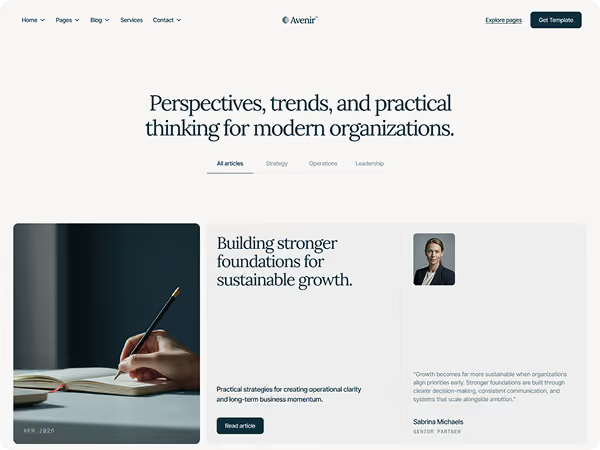
“Growth becomes far more sustainable when organizations align priorities early. Stronger foundations are built through clearer decision-making, consistent communication, and systems that scale alongside ambition.”
Communication as infrastructure
Communication is often underestimated because it feels intangible. Yet for growing organizations, communication functions as operational infrastructure. Misalignment rarely emerges from lack of effort — it emerges when assumptions replace clarity.
Teams move faster when expectations are documented, decisions are visible, and objectives remain consistent across departments. A stronger communication culture reduces confusion, improves accountability, and helps organizations adapt more confidently when priorities shift.
This becomes increasingly important during periods of accelerated growth, where even minor misunderstandings can create measurable inefficiencies across teams. Consistency, in this context, becomes a strategic advantage.
Building momentum through operational confidence
Momentum is often misunderstood as speed.
In reality, long-term momentum comes from confidence — confidence that teams understand priorities, confidence that communication supports execution, and confidence that systems will remain stable as organizations grow. The strongest businesses rarely move the fastest all the time.
They move deliberately. They make clearer decisions earlier. They reinforce alignment before friction compounds. And they understand that sustainable growth is built long before it becomes visible externally. Foundations are rarely glamorous work. But they are the reason growth lasts.



.avif)